
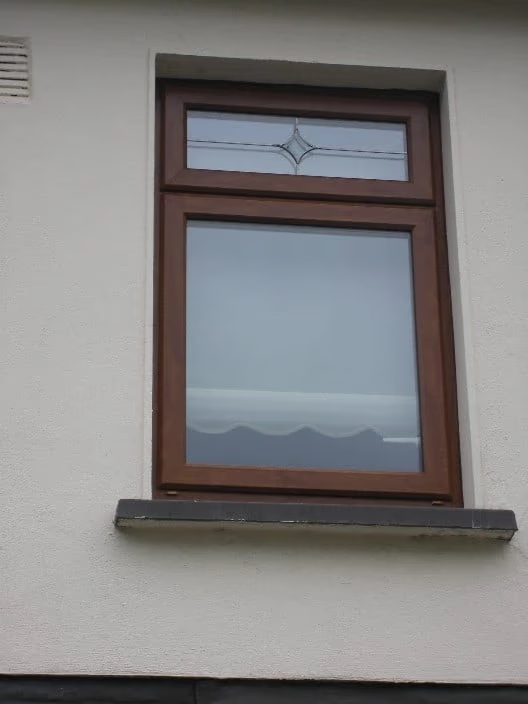
“Do I really need those vents at the top of the window?” comes up on almost every quote. Homeowners worry about draughts, noise and heat loss — and many had condensation problems with their old windows and assume new sealed windows will fix it alone. After 5,247 installations since 2003, here is the honest position on trickle vents, condensation and what Irish building regulations actually require.
The short answer: Most Irish homes do need background ventilation when windows are replaced — Building Regulations Part F require it where no mechanical ventilation exists. Trickle vents are the simplest way to provide it: no draughts, negligible heat cost, and they genuinely reduce condensation by letting moist air escape continuously. If you dislike the look, tilt-and-turn windows or wall vents do the same job. Vents cost €20–€30 per window (often nothing) at order stage — retrofitting later is the expensive way.
What is a trickle vent?
A trickle vent is a small, controllable slot built into the top of a window frame. Open or closed by a simple flap, it lets a slow, steady stream of fresh air into the room even when the window is locked shut. An external hood keeps rain and insects out and baffles noise. Unlike opening a window on a night latch, a trickle vent is secure, draught-free and works 24 hours a day — exactly what “background ventilation” means in the regulations.
Why Irish homes get condensation in the first place
Condensation is a humidity problem meeting a cold-surface problem. Everyday life — cooking, showers, drying clothes, even breathing — puts litres of moisture into your indoor air. That moisture condenses on the coldest surfaces it can find, which in an Irish winter is usually the glass:
- Cold surface: old single glazing or failed double glazing lets the inner pane get cold, so moisture condenses on it.
- High humidity: older windows leaked air (and moisture) through gaps. New A-rated windows seal the house — great for heat, but the moisture now has nowhere to go unless ventilation is provided.
- The trap: fit sealed new windows with no ventilation and condensation often gets worse — it just moves from the glass to colder walls, where it causes mould.
This is why A-rated double glazing and background ventilation are a package deal. The glazing warms the inner pane; the vent removes the moisture. One without the other solves only half the problem.
Do you actually need trickle vents? What the regulations say
Irish Building Regulations Part F (Ventilation) require adequate means of ventilation in every habitable room. When windows are replaced, the guidance is that ventilation must be no worse than before — so if your old windows had vents (or were so draughty they ventilated by accident), the replacements must provide equivalent background airflow. Rooms with a working mechanical extract or dedicated wall vent already comply; rooms with neither need vents on the new windows. On every survey we check what each room has and specify accordingly — you will never be sold vents a room does not need.
| Room situation | Trickle vent needed? |
|---|---|
| Old windows had vents; no mechanical ventilation | Yes — maintain what was there |
| Bedrooms and living rooms, no wall vent or extract | Yes — or an equivalent (tilt-and-turn, wall vent) |
| Kitchen / bathroom with working extract fan | Optional — extract covers it |
| Room with an open fireplace or existing wall vent | No — ventilation already provided |
Do trickle vents cause draughts, noise or heat loss?
No to all three, when they are properly sized and positioned. A trickle vent sits high in the frame, well above head height, and moves air too slowly to feel like a draught. The external hood baffles road noise far better than an open window (acoustic-rated vents exist for busy roads). The heat cost is small and more than repaid: damp air costs more to heat than dry air, so a ventilated room actually heats cheaper than a damp, sealed one. And every vent closes fully whenever you want it shut.
The alternatives: tilt-and-turn, wall vents and extract fans
If you dislike the look of a vent canopy, you have options. Tilt-and-turn windows tilt in at the top to give secure, adjustable background ventilation with no visible vent — the neatest solution, at roughly €100–€150 more per window than a casement. A simple wall vent satisfies Part F where frames cannot take a vent. Kitchens and bathrooms are usually covered by a working extract fan. What does not work is relying on “opening the window for ten minutes” — purge ventilation is required in addition to, not instead of, background ventilation.
The bottom line
If your old windows had vents, or the room has no mechanical ventilation, fit the trickle vents — they cost €20–€30 per window at order stage (frequently included), cause no draughts, and protect your new windows from the condensation problems sealed houses develop. Prefer nothing on the frame? Specify tilt-and-turn for secure background airflow instead. Either way, decide at survey: retrofitting vents later is the one genuinely expensive route. For room-by-room advice and an itemised quote — see our 2026 window prices guide for full costs — Owen responds within 24 hours and arranges a free survey.