
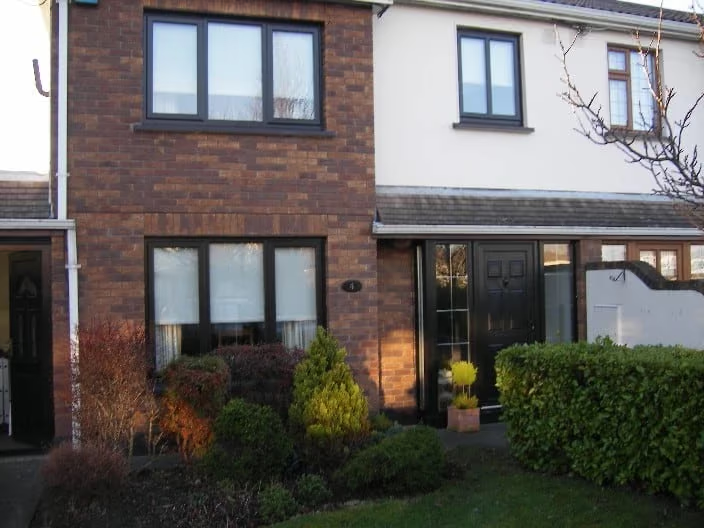
A picture window does one job and does it brilliantly: it frames a view and floods a room with light. No hinges, no handles, no opening sash — just glass. They are the most-requested style on extension projects we survey, and one of the most misunderstood: people fall for the look, then ask where the air comes from. Here is the honest guide to where picture windows work in Irish homes, the one trade-off to plan for, and real 2026 prices.
The short answer: A picture window is a large fixed, non-opening pane — maximum glass and the slimmest sightlines, at €500–€900 + VAT fitted (cheaper per square metre than openers). Ideal for garden-facing sitting rooms, gable ends, stairs and landings. The one trade-off: no ventilation, so always pair it with opening windows or doors. A-rated fixed units qualify for the SEAI grant (€1,500–€4,000) exactly like opening windows.
What is a picture window?
A picture window is a fixed pane of glass set directly in the frame — it never opens. Removing the opening mechanism buys you three things: more glass and less frame in the same opening, a cleaner, uninterrupted view, and a slightly better seal (one continuous gasket, no hinge or lock points). Picture windows can be almost any shape — standard rectangles, full-width walls, arched heads, floor-to-ceiling panes — and because there is no hardware, they cost less per square metre than an opening window of the same spec.
Where picture windows work in Irish homes
- Sitting rooms facing the garden: the classic use — one big fixed pane where the view matters, flanked by an opening casement or a set of French doors for air.
- Gable ends and extensions: full-height panes on new extensions, often beside sliding patio doors, where the doors handle ventilation.
- Stairs and landings: tall fixed panes that pour light down the stairwell — a space where you never needed an opener anyway.
- Over and beside doors: top-lights and sidelights brightening hallways without another opening to secure.
- Anywhere with a view worth framing: Wicklow hills, a mature garden, even a well-planted courtyard — the pane disappears and the view becomes the picture.
Ventilation — the one trade-off to plan for
A fixed pane gives no airflow, full stop. Every room still needs background and purge ventilation, so a picture window should never be the only glazed element in a living space. The pairings we fit most often: a picture pane beside an opening casement in the same room, or a tilt-and-turn window nearby — the tilt position gives secure, continuous background ventilation while the big pane does the view. Plan the two together at survey stage and you lose nothing.
Prices and grants — the honest 2026 numbers
Fixed panes are the best-value glazing per square metre because you pay for glass and frame, not hardware. Our typical fitted prices:
| Picture window size | Typical fitted price (ex VAT) |
|---|---|
| Small (e.g. landing or top-light, under 1m²) | €500–€600 |
| Standard sitting-room pane (1–2m²) | €600–€800 |
| Large pane (2–4m²) | €800–€900 |
| Floor-to-ceiling / shaped / gable glazing | Quoted after survey |
Every pane is A-rated as standard (Pilkington K Low-E, argon-filled, warm-edge sealed), and large or low-level panes get toughened or laminated safety glass as regulations require. Fixed units count fully toward the SEAI windows grant — €1,500–€4,000 by home type — on pre-2011 homes. See how a picture window fits into whole-house costs in our 2026 window prices guide.
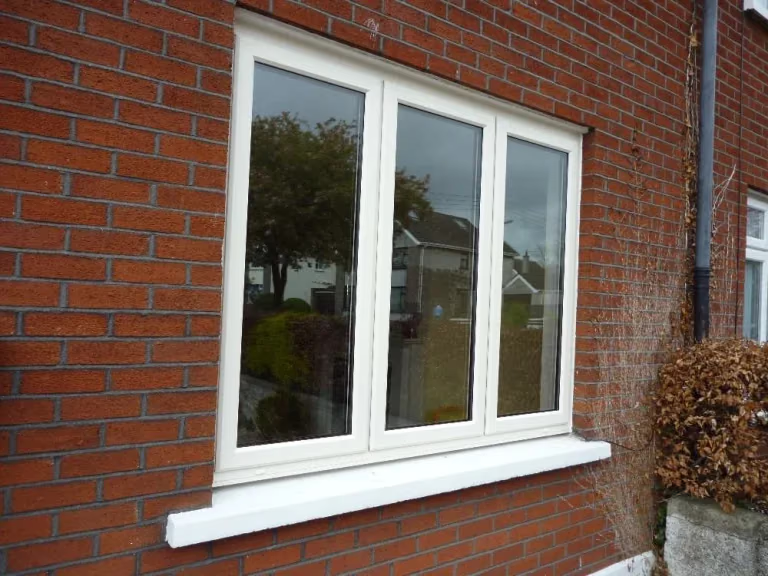
The bottom line
Where a view or light matters more than an opener, a picture window is unbeatable value — €500–€900 + VAT fitted, A-rated, grant-eligible, with the slimmest sightlines we fit. Just plan ventilation alongside it (a casement or tilt-and-turn in the same room) and spec safety glass on large or low panes. For sizing, structural questions on bigger openings, and a fixed written quote, Owen responds within 24 hours and arranges a free survey — or browse the full range on uPVC windows Dublin.