
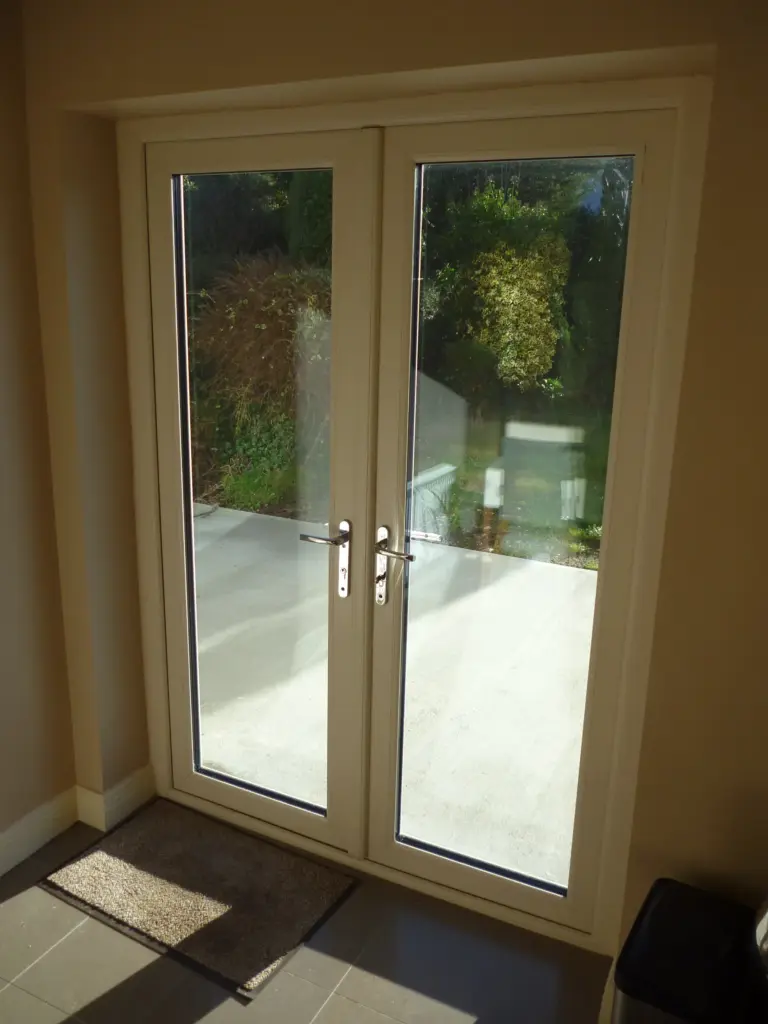
French doors are still one of the most-requested products on our books — the kitchen-to-garden upgrade that opens up an Irish semi-detached or terrace in ways a single back door never can. But the wrong spec costs you light, security, energy, or all three. After fitting French doors in over 1,200 Dublin, Kildare and Wicklow homes since 2003, here are the seven decisions that actually matter.
Indicative pricing for 2026: a standard 1.6 m wide uPVC French door pair fitted across Dublin costs €2,400 – €3,200 + VAT, including the side frame, multi-point lock, removal of the old unit and full make-good. The SEAI Better Energy Homes grant covers up to €1,800 if the door achieves an A-rated thermal performance — which most modern French door units now do as standard.
1. Measure the Opening Width — Honestly
French doors look right when the structural opening is at least 1,500 mm wide. Below 1,400 mm you end up with narrow leaves that look pinched, swing inefficiently, and offer little practical advantage over a single back door. Above 2,200 mm you should be looking at sliding or bifold doors instead, where each panel does not require swing clearance on the inside.
Standard Irish openings sit at 1,500–1,800 mm — comfortable for a balanced pair of French doors. If you are unsure, our surveyor measures every opening with a laser level and writes the finished frame size onto the quote so there is no ambiguity later.
2. Inward Swing or Outward Swing?
Outward-opening French doors are the default in Ireland and the right choice in roughly 80% of homes. They free up internal floor space (a 800 mm leaf does not swing across your kitchen island), they seal better against driving rain, and they pass weather-rating tests at higher pressures — meaningful on exposed coastal sites in Bray, Greystones or Howth.
Inward-opening French doors only make sense if the external space is shallow (a tight rear courtyard, a balcony, a passage) or if you specifically want internal flush thresholds for accessibility. They are slightly more expensive (€80–€120 per door) because the threshold spec is different.
3. Glazing: Double or Triple?
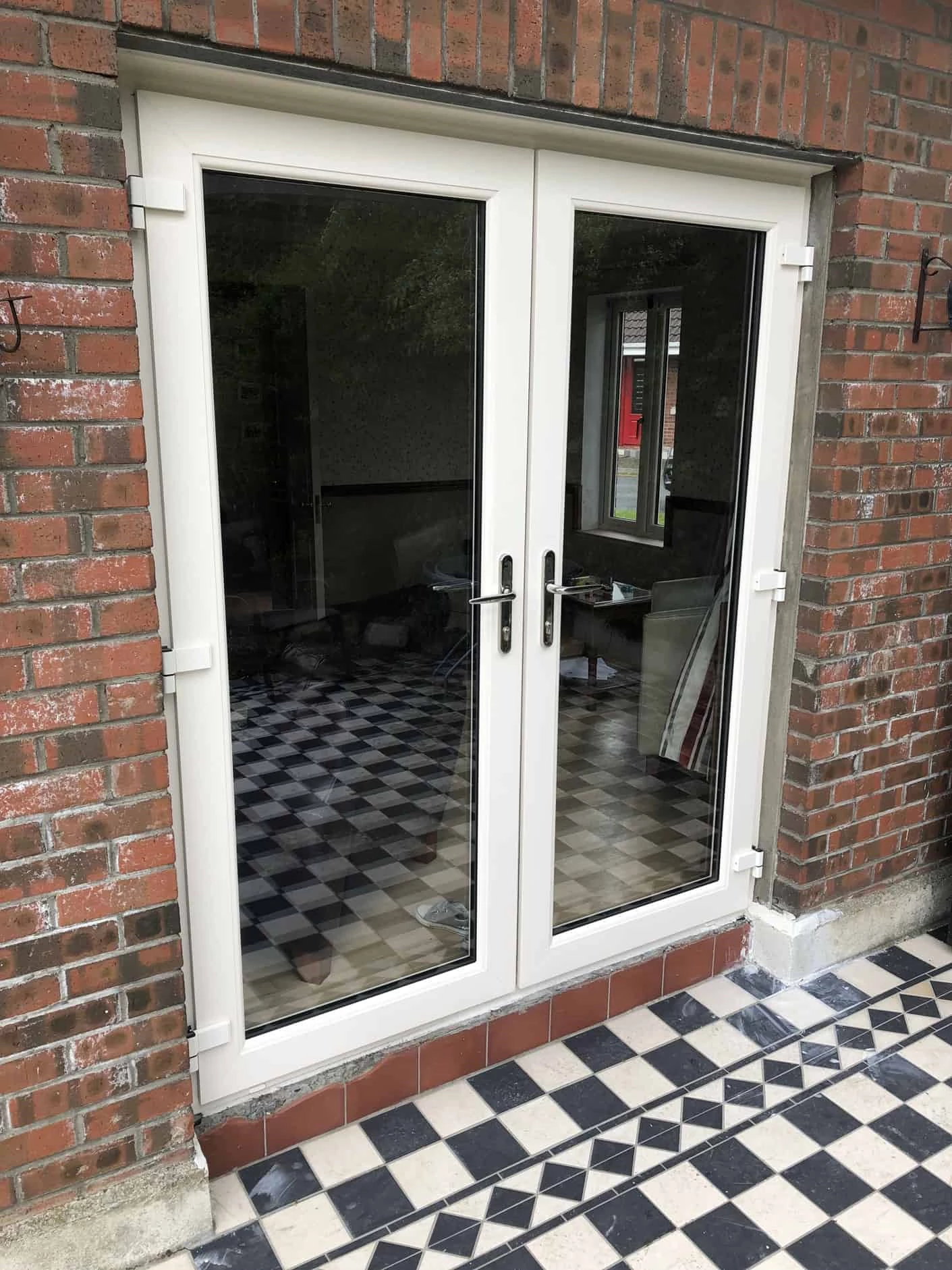
Both options qualify for the SEAI grant in 2026, but they perform differently. Double-glazed French doors (4-20-4 unit with low-E coating and argon fill) hit a U-value around 1.4 W/m²K — solidly A-rated and the right choice for most rear-of-house installs. Triple-glazed units push that down to 0.8–1.0 W/m²K, worth the €350–€500 upgrade if the doors face north or you are reducing heating cost across the whole envelope.
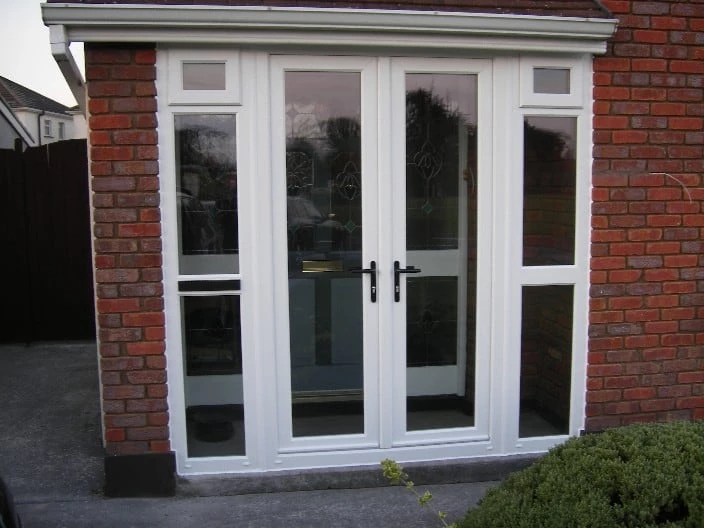
Avoid leaded or Georgian-bar inserts unless you specifically want the period look — they cut natural light by 8–12% and add a cleaning headache. For full garden views and maximum daylight, specify clear toughened glass with a single low-profile mid-rail or no bars at all. If you are unsure between double and triple, read our uPVC vs composite doors comparison for the door-frame side of the same decision.
4. Security: Multi-Point Locking is Non-Negotiable
French doors are the most-targeted entry point in Dublin burglary statistics — partly because rear gardens are not overlooked, partly because older installs used basic shootbolts. Every French door we install now ships with a minimum 3-point multi-point lock, hook-bolt deadlocks at top and bottom, anti-snap euro cylinder (TS 007 3-star), and laminated low-E glass that does not shatter into accessible shards.
If your insurer asks for proof, all of the above is documented on the post-installation certificate. Sliding doors offer similar security through laminated glass and multi-point hooks — see our sliding patio doors page for the comparison.
5. Frame Material: uPVC, Aluminium or Composite?
For French doors, uPVC is the right call in roughly 85% of Irish homes. It is the most thermally efficient frame material per euro, available in 12+ foiled wood-grain finishes and solid colours, requires zero maintenance, and qualifies easily for the SEAI grant. Aluminium frames give slimmer sightlines and a modern minimalist look but cost 60–90% more and have weaker thermal performance per profile width. Composite is rarely specified for French doors because the panel structure does not benefit from the same solid-core advantage as a single composite front door.
If kerb appeal is the priority and budget allows, aluminium-clad uPVC ("Aluclad") gives you the slim aluminium look outside and the thermal performance of uPVC inside — popular for contemporary new-builds in North Kildare and the Greystones coastal belt.
6. Threshold Type: Low-Rise, Standard or Flush?
Three threshold options are worth knowing about:
- Standard (40–60 mm) — the most weather-resistant, best for exposed sites and homes within 5 km of the coast.
- Low-rise (20–30 mm) — sensible compromise. Walking through with shopping bags is easy; weather rating stays at ≥1A.
- Flush (0 mm with drainage channel) — for accessibility (Part M compliance) or where a continuous flooring run is desired between kitchen and patio. Requires careful detailing — get the surveyor's written sign-off.
For homes in Tallaght, Lucan, Naas or other inland sites, low-rise is usually the sweet spot. Coastal homes in Bray, Greystones or Skerries should default to standard threshold unless a covered patio is in place.
7. Installer, Warranty and SEAI Eligibility
Three checks before signing a quote:
- Is the company SEAI registered? Required for the €1,800 grant. Airtight is registered — list your contractor reference number on the SEAI application.
- Is the warranty in writing for both the door unit (10 years) and the workmanship (10 years)? Many installers cover only the unit.
- Do they have €2 million public liability insurance? Ask to see the certificate. We carry it as standard on every job.
For the SEAI grant specifically, see our dedicated SEAI Grant for Windows & Doors page — covers eligibility, BER requirements and the post-installation BER inspection.
The Bottom Line
For a typical Dublin semi-detached extending out to a rear garden: 1,500–1,800 mm outward-opening uPVC French doors, A-rated double glazing, multi-point lock with anti-snap cylinder, low-rise threshold, fitted by an SEAI-registered installer with written 10-year workmanship cover. Expect €2,400–€3,200 + VAT before the €1,800 grant.
We will measure your opening, talk through which of the seven points matter most for your specific home, and write a fully itemised quote within 24 hours. Call 01 822 8982 or request a free survey.
Free French Door Quote — Within 24 Hours
No deposit. No pushy salespeople. Honest itemised pricing with SEAI grant guidance built in.
Call 01 822 8982